Showing posts with label Christensen. Show all posts

Wednesday, August 23, 2023

Rasmus? No, Robert.

One of my immigrant ancestors, my great-great grandfather, Rasmus Pedersen, was born on May 22, 1852, in Frejlev, a tiny village on the island of Lolland, Denmark. His father, Peder Olsen, was a blacksmith. Rasmus and his brothers were also trained to be blacksmiths. Starting with brother Hans in 1879, the entire family migrated to the United States by 1882, most of them settling near Waupaca, Wisconsin.

Rasmus married Karen Pedersen in April 1880 and they arrived in Racine, Wisconsin in time to be recorded in the 1880 US Census for that place. While living in Racine from 1880 to 1883, Rasmus worked as a blacksmith and the couple welcomed two daughters – Gertrude and Marie. Shortly after Marie's birth, the couple joined many other Danish immigrants, settling in Howard County, Nebraska. They helped establish the new village of Nysted, not far from the town of Dannebrog.

It was about this time that Rasmus adopted the more American-sounding name of Robert Petersen. He is recorded in the 1885 state census of Nebraska under that name, and he used it for the rest of his life.

The reason for this post is that I recently learned of another family member – also a descendant of my Danish blacksmith ancestor – who made the same name choice.

Robert and Karen's daughter, Marie, married C.A. Christensen in 1904. The eldest of their nine children was born in 1906 and named Oswald. Official documents record his name as Oswald Robert Christensen. However, at a recent family reunion, a member of his immediate family informed me that he was named Oswald Rasmus by his parents, and that he also chose to use Robert instead. We don't really know when or why he decided to make the change. Perhaps it was around the time of World War One, when many immigrants and children of immigrants preferred not to have "foreign" names. That is speculation on my part, however. "Uncle Os" was the eldest brother of my maternal grandfather, Clifford "Kip" Christensen.

Want to learn more?


Monday, May 30, 2022

Marie (Petersen) Christensen – United States Citizen or Not?


Marie (Petersen) and Christian A (C.A.) Christensen about the time of their marriage in 1904.

The United States is a "Nation of Immigrants," in a phrase popularized by a 1958 book written by then-Senator John F. Kennedy. From colonial times until now, waves of people have come to this land seeking to make a better life for themselves and their families. It must be acknowledged that these waves dispossessed the Native peoples who had lived in North America for thousands of years, and that hundreds of thousands of others were brought here against their wills to be enslaved.

Many Americans celebrate their immigrant ancestries and honor the contributions their forebears have made to building the country in which we live. The ugly side of the story is that each wave of immigrants were met with prejudice, stereotypes, and discriminatory laws and social treatment.

According to the editors of History.com

"Between 1880 and 1920, a time of rapid industrialization and urbanization, America received more than 20 million immigrants....The peak year for admission of new immigrants was 1907, when approximately 1.3 million people entered the country legally."

My great-grandparents, Marie (Petersen) Christensen, and her husband, Christian Andrew (C.A.) Christensen were part of this wave and found themselves caught up in the backlash.

Marie was born in Racine, Wisconsin, on 27 February 1883, to Danish immigrants Robert and Karen Petersen. Marie was granted citizenship by birthright, a privilege extended by the 14th Amendment to all people born in the United States or its territories. C.A. Christensen was born in Denmark in 1881 and came as a child in 1888 to Wisconsin with his parents, Jens and Caroline. He would remain a Danish citizen until such time as he would complete the Naturalization process.

It is unlikely that Marie and C.A. gave much thought to the citizenship implications of their marriage in January 1904. I believe they were more focused on where they would live and how they would support the family they hoped to build together.

Although it may seem surprising today, there was a time in the United States when the citizenship of a married woman was tied to the citizenship of her husband. This principle was embodied in federal law when the U.S. Congress passed the Expatriation Act of 1907, which stated that "any American woman who marries a foreigner shall take the nationality of her husband."

According to Meg Hacker, of the U.S. National Archives:

If an American woman married a foreigner before 1907 and the married couple continued to reside in the United States, she did not, because of her marriage, cease to be an American citizen. The American woman remained a U.S. citizen even after her marriage to a non-U.S. citizen.

Even though Marie and C.A. were married in 1904, they apparently believed that she had lost her citizenship by marrying a Danish citizen. They must have been relieved when Congress passed the Cable Act of 1922 (approved 22 September 1922, it was also known as the Married Women's Citizenship Act or the Women's Citizenship Act). Both Marie and C.A. petitioned to become naturalized American citizens – in Marie's case, she petitioned to have her birthright citizenship restored – in August 1924.

The section of Marie's petition form where she was to declare her intention to become a citizen of the United States was crossed out...

and covered by the following typescript statement:

Marie's United States Citizenship was restored on 27 February 1925. Here is her Certificate of Naturalization:

C.A. was granted citizenship in February 1925 at the same time as Marie, but that's another story...

 Sources:

"Cable Act of 1922", Immigration History, a project of the Immigration and Ethnic History Society (2019); web page (https://immigrationhistory.org/item/cable-act/ : Accessed 30 May 2022).

Hacker, Meg, "When Saying "I Do" Meant Giving Up Your U.S. Citizenship", Prologue (Spring 2014), U.S. National Archives and Records Administration, College Park, Maryland; digital article (https://www.archives.gov/files/publications/prologue/2014/spring/citizenship.pdf : Accessed 29 May 2022).

History.com editors, "U.S. Immigration Before 1965", History, A&E Television Networks (10 September 2021);digital article (https://www.history.com/topics/immigration/u-s-immigration-before-1965 : Accessed 29 May 2022).

"Expatriation Act of 1907", Immigration History, a project of the Immigration and Ethnic History Society (2019); web page (https://immigrationhistory.org/item/an-act-in-reference-to-the-expatriation-of-citizens-and-their-protection-abroad/ : Accessed 30 May 2022).

“Naturalization Records, 1853-1943”, Waupaca County, Wisconsin, Clerk of Courts. Petitions, 1921-1925, Waupaca Series 16, Volume 9, Petition No. 879, Filed 2 August 1924, Marie Petersen Christensen; digital images, FamilySearch.org, “Wisconsin County Naturalization Records, 1807-1992”, (https://www.familysearch.org/ark:/61903/1:1:ZXSV-NXN2 : 30 May 2022) image nos. 246-250. (Viewing the image of Marie's petition requires a free-of-charge FamilySearch.org account)

“Naturalization Records, 1853-1943”, Waupaca County, Wisconsin, Clerk of Courts. Petitions, 1921-1925, Waupaca Series 16, Volume 9, Petition No. 866, Filed 1 March 1924, Christian Andrew Christensen; digital images, FamilySearch.org, “Wisconsin County Naturalization Records, 1807-1992”, (https://www.familysearch.org/ark:/61903/1:1:ZZMK-5Q2M : accessed 30 May 2022), image nos. 206-209. (Viewing the image of C.A.'s petition requires a free-of-charge FamilySearch.org account)

Wikipedia contributors, "Cable Act," Wikipedia, The Free Encyclopedia, https://en.wikipedia.org/w/index.php?title=Cable_Act&oldid=1084647817 (Accessed May 30, 2022).

Sunday, January 3, 2021

Os and Jennie Christensen on their wedding day, April 4, 1928


These photos show Oswald R Christensen (1906-1989) and Jennie Douglas Rait (1908-1994) on their wedding day, April 4, 1928. Os and Jennie farmed and made a family in Iola, Waupaca County, Wisconsin. Their home was the gathering place for their many siblings, nieces, nephews, friends and others. It was a place where people always felt welcome. Photos courtesy of Dana Christensen Zarling, their granddaughter.

Sunday, November 10, 2019

Grandfather's War – Clifford A. “Kip” Christensen in World War II

November 21, 2019 is the 100th anniversary of the birth of my maternal grandfather, Clifford Alvin “Kip” Christensen. This seems a good moment to recount what we know about his service in World War II. All who knew him agree that his service in Europe marked him profoundly. The horrors of war shook a young man who was intelligent and charismatic, but who had a dark turn of mind, and a weakness for drink that brought out a mean streak in his character. 

When my grandparents, Kip Christensen (1919-1972) and Audrey Radloff (1921-2000), married in Chicago in May 1941, the future must have seemed bright for them. A handsome couple with movie star looks, of which they were more than a little bit vain, they had come through the worst of the depression trusting that hard work would see them through.
Wedding photo, May 1941, Chicago, IL

Less than one year later, the young couple suffered the hard blow of a son born to live only one week. The infant Rodney died on April 16, 1942. Kip traveled by train from Chicago to Waupaca with a small white coffin on his lap, taking his son home to be buried.

Possibly looking for a fresh start, Kip and Audrey moved to Detroit, Michigan in the summer of 1942, along with thousands of others, as the city and its automobile industry transformed itself to become America's wartime manufacturing powerhouse. Ford Motor Company's gigantic Willow Run Plant alone would employ more than 40,000 at one time and would produce 8,865 heavy B-24 Liberator bomber aircraft by the end of the war. Tensions in the crowded city exploded into violence between blacks and whites for about 24 hours in June 1943, until federal troops enforced order. 
February, 1943, Detroit, MI

On November 29, 1943, Just over a week after Kip's twenty-fourth birthday, he reported to the Recruit Reception Center at Fort Sheridan in Lake Forest, IL. Just a few days later, he was shipped out to the Field Artillery Replacement Training Center at Camp Roberts, CA. He spent several months there, qualifying to be a Cook and to operate the Army's field artillery pieces.
Fort Sheridan, Lake Forest, IL, November, 1943


Camp Roberts, CA, 1944

Training as a Cook earned Kip a Technician, 4th Class (or Tec-4) Rank, allowing him to be paid as – and addressed as – Sergeant. The Tec-4 patch (see inset in photo with overalls) has three chevrons and a letter “T”.
Artillery Training at Camp Roberts, CA, 1944

In April, 1944, Kip was assigned to the 97th Infantry (Trident) Division, 365th Field Artillery Battalion, and ordered to report to Fort Leonard Wood, MO by May 10, 1944.
Kip's assignment to the 97th Infantry Division at Fort Leonard Wood, MO.

Here is the uniform shoulder patch of the 97th Infantry Division – the Trident:
The 97th Infantry Division crossed the submarine-infested Atlantic Ocean during the final week of February, 1945, arriving at Le Havre, France on the first day of March. After staging at Camp Lucky Strike, France, the Trident Division crossed into Germany on March 28, 1945, passing near the devastated town of Aachen.

The 97th arrived in time to participate in one of the last major battles of the war in Europe – The Battle of the Ruhr Pocket. During the first two weeks of April, 1945, German Army Group B, with about 350,000 troops under the command of Field Marshal Walther Model, was encircled and defeated. Seventeen American divisions, including the 97th, were part of this climactic effort.


 Trident Division Campaign Maps, April 1-18, 1945

With German forces dissolving between the 16th and the 18th of April – more than 300,000 German troops surrendered to become POWs – the battle of the Ruhr Pocket was over, and the 97th Infantry Division was redeployed. The Trident Division was moved to the German-Czechoslovakian border to hold down the left flank of the U.S. Third Army as it moved south and east through Germany and Austria. The 97th Division's first objective was to take the city of Cheb, Czechoslovakia.

As preparations for invading Czechoslovakia went forward, the Flossenburg concentration camp was discovered within the Division's sector of control. When troops of the 90th Infantry Division discovered the camp on April 23, 1945, approximately 2,000 weak and ill prisoners remained in the camp, and unburied corpses lay on the ground. The Nazi SS (Schutzstaffel), which ran the camp to house political prisoners, Jews and others, had been evacuating the camp as U.S. Army forces closed in during April, 1945. They forced prisoners on a 125-mile death march south to a German-controlled camp near the village of Posing. 

According the U.S. Army's website history of the camp's liberation (link below):
The 97th Division performed many duties at the camp upon its liberation. They assisted the sick and dying, buried the dead, interviewed former prisoners and helped gather evidence against former camp officers and guards for the upcoming war crimes trials.
I do not know what duties my grandfather was called upon to perform. As a child, I was told or came to understand that he had taken part in the liberation of a German concentration camp, and that it gave him nightmares for the rest of his life.

One more quote from the U.S. Army website history of the liberation:
One eyewitness U.S. Soldier, Sgt. Harold C. Brandt, a veteran of the 11th Armored Division, who was on hand for the liberation of not just one but three of the camps, Flossenburg, Mauthausen, and Gusen, when queried many years after the war on his part in liberating them, stated that "it was just as bad or worse than depicted in the movies and stories about the Holocaust. . . . I can not describe it adequately. It was sickening. How can other men treat other men like this'"

With operations in Czechoslovakia between April 25 and May 7, 1945, the 97th Infantry Division was involved in some of the final hostile actions to take place in the European Theater of war. The Division met uneven resistance – at times almost none at all; at times, quite determined – as it drove to take Cheb from April 26th through 28th, 1945 and Pilsen on May 6, 1945. On May 7, all forces were ordered to halt offensive actions in expectation of the acceptance of the unconditional surrender of Nazi Germany's forces on May 8, 1945, known now as V-E Day (Victory in Europe). 
Trident Division campaign map – final days of war in Europe


Kip Christensen, Camp Old Gold, France, June, 1945

After a brief stay at Camp Old Gold, near Yerville, France, the 97th Infantry Division sailed on the S.S. Brazil troopship. They arrived at Camp Shanks, near Nyack, NY on June 24, 1945 and were granted thirty-day furloughs. The Division was to be redeployed to the Pacific for the expected invasion of Japan, but the destruction of the cities of Hiroshima and Nagasaki by atomic weapons led to Japan's surrender on September 2, 1945. Elements of the 97th Infantry Division did participate in the occupation of Japan, but Kip Christensen was not among them. He was given an honorable discharge from Division Headquarters at Camp San Luis Obispo, CA on October 22, 1945. 


Military Service Milestones for Clifford A Christensen:


29 NOV 1943 – Enlistment – Recruit Reception Center, Fort Sheridan, Lake Forest, IL.

DEC 1943 – Field Artillery Replacement Training Center, Camp Roberts, CA for training on cook duties and in use of 105mm howitzer artillery.

MAY 1944 – Assigned to 97th Infantry Division (Trident Division), 365th Field Artillery Battalion, Special Services Battery, Fort Leonard Wood, MO.

JUL 1944 – Earmarked for assignment to the Pacific Theater, Division relocated to Camp San Luis Obispo, CA for training in amphibious landing operations.

SEP 1944 – Division relocated to Camp Cooke, CA for further amphibious training.

DEC 1944 – Heavy losses to American forces in the Battle of the Bulge cause Division to be reassigned to European Theater.

1 MAR 1945 – Division arrives Le Havre, France; proceeds to Camp Lucky Strike staging area.

28 MAR 1945 – Division crosses into Germany west of the city of Aachen.

1 APR – 18 APR 1945 – Battle of the Ruhr Pocket.

23 APR – 30 APR 1945 – Troops of the 90th and 97th Infantry Division liberate the Flossenburg Concentration Camp near the border of Germany and Czechoslovakia.

23 APR – 6 MAY 1945 – 97th Infantry Division redeployed to German-Czechoslovakian border to hold left flank of U.S. Third Army's drive into southeastern Germany and Austria.

7 MAY 1945 – All American forces in Europe ordered to halt offensive action.

8 MAY 1945 – Allied forces accept unconditional surrender of its armed forces by Nazi Germany (Victory in Europe, or V-E Day).

Late MAY to mid-JUN, 1945 – Camp Old Gold, near Yerville, France.

24 JUN, 1945 – Division arrives at Camp Shanks, near Nyack, NY on the troopship S.S. Brazil; granted thirty-day furlough.

22 OCT 1945 – Honorable discharge; Camp San Luis Obispo, CA 

Internet resources consulted in researching this post: 

The 97th Infantry Division During World War II (http://www.97thdivision.com/historyp1.html) Accessed 9 NOV 2019.

Dabrowsky, John R., Colonel, U.S. Army Heritage and Education Center. “U.S. Army Liberates Flossenburg Concentration Camp.” U.S. Army. https://www.army.mil/article/8441/us_army_liberates_flossenburg_concentration_camp. 11 APR 2008, Accessed 10 NOV 2019.

United States Holocaust Memorial Museum. “Encircling the Ruhr.” The Holocaust Encyclopedia. https://encyclopedia.ushmm.org/content/en/article/encircling-the-ruhr. Accessed on 9 NOV 2019.

Sunday, June 23, 2019

EXTRA!! WOMAN KILLED BY TRAIN -- The life and shocking death of Caroline Christensen


Caroline Christensen (1842-1922) was my great-great grandmother. She was born in Denmark and there married Jens P. Christensen in 1868. They and their three sons -- Lauritz Marinius, Christen Norgaard, and Christian Andrew -- emigrated to Waupaca, Wisconsin in 1888.

Family lore has it that, on the afternoon of Thursday, October 26, 1922, Caroline set off to visit her friend, Mrs. Hanley, who lived across the railroad tracks from her home; and that her deafness likely contributed to the accident that killed her when she was hit by the Soo Line passenger train, No. 2. 

Here are the newspaper stories published about the accident and her obituary:


Saturday, August 25, 2018

Ethel May RADLOFF (nee DAVIES) at age 96 (1981) - in her own voice


From left to right, Frank RADLOFF, Ethel May RADLOFF (née DAVIES), Audrey CHRISTENSEN (née RADLOFF), Harold RADLOFF, Adeline RADLOFF, Wilma SHANKLIN (née RADLOFF); Waupaca, Wisconsin; February 1943. (Howard RADLOFF is absent from photo, probably away in military service at that date)

In the early 1980s, my grandmother and her sisters pinpointed me as the young person in the family most likely to be interested in the family history. In August, 1981, my great-Aunts Adeline AYRES and Wilma SHANKLIN (both née RADLOFF) were inspired to record their mother, Ethel May RADLOFF (née DAVIES) telling about her life, and to send the audiocassette to me.

Here is a brief audio clip (.MP3 format) of my great-grandmother telling about her life at age 96:

Saturday, July 14, 2018

Family Photo Comes "Home" (Thanks to a Good Samaritan)

Have you ever seen an old photograph in an auction or antique store and felt a pang of sadness because family treasures had become lost to people who would care for them? I have recently come into contact with two people who try to restore those lost artifacts to people or places where they will be valued. 

As Director of the Oshkosh Public Library in Wisconsin, I recently received three letters that had been written in the 1860s by an area farmer to his mother in Michigan. The man who sent them visits sales and antique stores, purchases "orphaned" historical artifacts such as photos and letters, and tries to find suitable homes for them. While the Oshkosh Public Library does not collect such artifacts, our Local History Librarian will offer them to the historical society of the city where the letter writer lived.

A short time after receiving the 19th century letters in my professional role as a library director, I again encountered someone whose hobby is to help historic artifacts find their way to good "homes," although this time I had a personal interest in the matter. Through my account on Ancestry.com, I received the following message one day in May 2018:
Hello, I came across a photo at an antique store in Appleton that states on the back: Grandma & Grandpa Christensen, Property of E.J. Christensen. Matches up with the photo of Jens Christensen on your tree and includes who I think may be Caroline Sorensen. If interested, I can send it to you.
 Of course, I immediately expressed my interest. As it turns out, I pass by the fellow's workplace every day as I commute to and from my own work. We made arrangement for me to pay for the photo (he would accept only what he paid) and to pick it up. 

So, one morning in June, 2018, I stopped by the security desk of his workplace and, for the first time, got to see a photo of both my great-great grandparents together.

Here is the photo of Jens Peter Christensen and his wife Caroline Josephine (nee Sorensen), who immigrated in 1888 from their home near Aalborg, Denmark to Waupaca County in Wisconsin:


And here is the photo of Jens from his profile on my Ancestry.com family tree, which my Good Samaritan saw and recognized in the photo he had purchased:


When I carried my new acquisition and my story to the Christensen family reunion in Waupaca, Wisconsin on June 24, 2018, I was just a little anxious that fifteen people would see it and say "Oh, yes, I have a copy of that photo." I was glad to learn that there is at least one copy of the photo already in the family, but that my "treasure" was also a welcome addition. 

Monday, January 1, 2018

Os and Jennie CHRISTENSEN farm, early 1940s

Photos taken on Os and Jennie's farm in 1941 and 1942


Dated in album as Spring 1941, from left to right. Back row, Clifford ("Kip") Christensen, Robert ("Bob") Christensen, Oswald ("Os") Christensen. Front row, Ron Hardel (son of Jennie's sister Alta), Donald Christensen, Dorothy Christensen, possibly Kenneth Dunn (son of Kip & Os's sister Mabel). One of the horses is "Prince". Identifications provided by Dorothy Inderdahl (nee Christensen), December 2017.


Dated in album as July 1942, left photo is Dorothy Christensen; right photo is Dorothy with Audrey E Christensen (nee Radloff)


 Dated in album July 1942, from left to right: Ron Hardel, Os Christensen, Bob Christensen, Don Christensen. Dorothy Christensen is between an unidentified couple, friends of Os and Jennie Christensen.

Saturday, December 16, 2017

RADLOFF Family post-war baby boom. Waupaca, Wisconsin, USA. October 1946.


All left to right. Back row: CA Christensen, Frank Radloff; left of stairs: Ruth Mortenson Radloff, Eileen Johnson Radloff, Wilma Radloff Shanklin, Adeline Radloff DeGodt; KIDS: David Shanklin, Dennis DeGodt, Donnie Radloff, Jay DeGodt with Lynn Christensen just behind, and Vicki Christensen; Right of stairs: Ethel Radloff, Kip Christensen, Harold Radloff, Art Shanklin.


Same farmhouse as in 1946 photo, November 2017, taken by Jason DeGodt. Farmhouse is just south of Highway 10 in Waupaca.

Wednesday, May 10, 2017

Kip Christensen during the Great Depression, 1937 - 1938

Clifford Alvin "Kip" Christensen (1919 - 1972). The group picture shows my grandfather ("Grampa Kip") with two co-workers. Kip graduated from Waupaca HS in 1937 -- the depths of the Great Depression. He found work as a dishwasher at the Exchange Building cafe in Chicago. Letters from home during that time encouraged him to stick with the job, because work was so hard to find. These letters frequently mentioned the difficulties that one or another of his brothers were having finding steady work. One letter, from his married sister Mable, shows that Kip was already showing signs of the alcohol abuse that would shadow his life. The second picture was taken in Driggs, Idaho, the Teton Valley, in 1938. The 19 year old Kip was working on the Jack Buxton ranch in Driggs, Idaho, along with his older brother Earl.

Kip Christensen at the union-sponsored rest tent, ca 1950

This photo of my Grandfather, Kip Christensen (1919-1972), shows him staffing a union-sponsored rest tent, probably at a county fair. The sign next to him says "Do You Have Any Questions About Unions? ASK US!" My Gramma Audrey was proud of her contributions to the United Auto Workers Local No. 21 in Traverse City, Michigan, which included service as its President. Kip and Audrey were dedicated supporters of the United Auto Workers, and its influential mid-20th century leader, Walter Reuther. Wikipedia has decent short articles on both subjects.

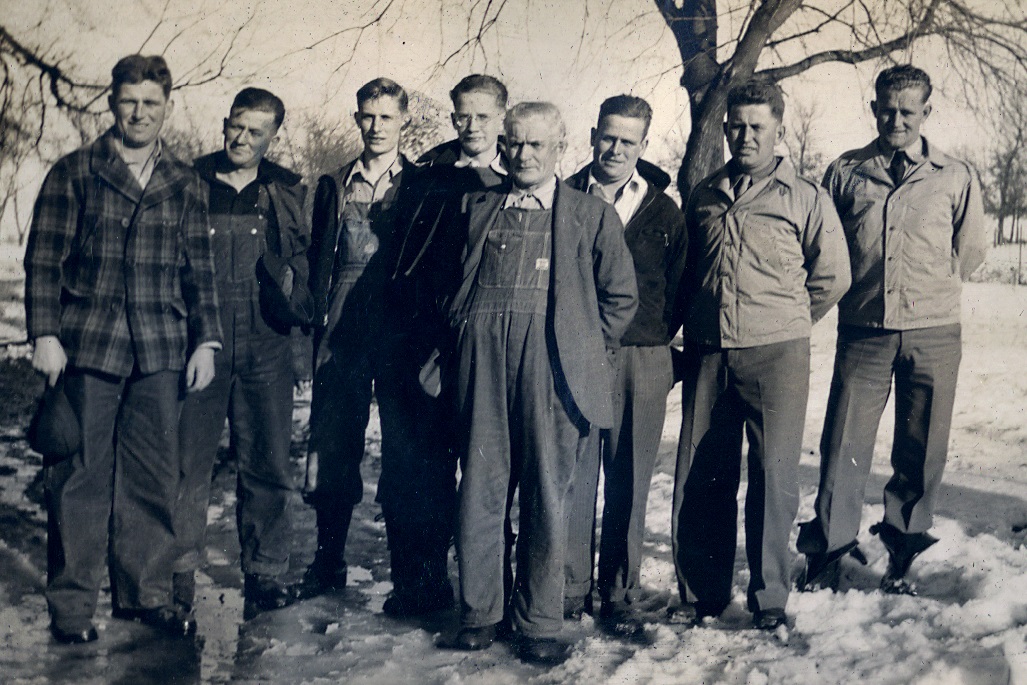
C.A. Christensen & sons, February 1943


This is a photograph of Christian Andrew "CA" Christensen and all of his sons on the occasion of the death of his only daughter in February 1943. Mabel was married to Leon Dunn and mother of three when she died at the age of 34 "after an operation," as the newspaper death notice put it.

Front and center is CA Christensen, who was born in Denmark in 1881 and came to the USA in 1888. His sons, from left to right in this photo, are Oswald R. "Os" (1906-1989), Earl H. (1909-1981), Clifford A. "Kip" (1919-1972),  William M. "Bill" (1927-2007), Edward P. (1916-1986), Carrol G. (1915-1993), and Arthur C. (1913-1996).

This photo was probably taken on the Dunn farm in the Town of Dayton, Waupaca County, Wisconsin.